 Polkastarter
 lets you lock POLS on Base to accrue MINT rewards
Polkastarter staking on Base uses locked POLS positions to accrue rewards in MINT. The deposited asset and reward asset have separate balances. A position's lock controls when you can withdraw POLS, while its estimated annual percentage rate (APR) describes a reward rate that can change. Wallet holdings, active stakes, and accrued rewards represent different amounts. Launchpad staking rules and the announced BNB Chain migration carry their own conditions, so they don't establish a universal Base withdrawal schedule.
Last updatedKey takeaway: The selected Base lock duration determines POLS availability, so compare its unlock date alongside the estimated reward rate.
Lock duration and access to your POLS
The lock duration attached to a Base staking position determines when its POLS becomes available for withdrawal. An active stake can remain locked while its reward counter increases. Choosing a term therefore commits the deposited POLS for that position's lock, independently of the amount of MINT it earns.
The interface presents a 'Login to Stake' control and displays whether a wallet is linked. The staking form puts the POLS amount alongside a lock duration, estimated APR, and unlock date. The duration and date describe access to the deposit; the APR estimates its rewards. Compare the availability date with the reward estimate before committing POLS. An empty duration selector provides no selectable term.
What does estimated APR tell you about MINT rewards?
Estimated APR expresses an annualized reward rate for a staking position, and the interface warns that this estimate may vary. An annualized figure doesn't promise that a shorter lock will earn a full year's rewards. Its percentage also doesn't fix either token's market value.
Reward units and estimated value
The Base staking interface identifies MINT as the reward token. The 'MINT earned' total belongs to that reward asset, while 'Active Staked' reports the POLS committed to positions. Their units remain distinct even when both amounts appear on the same screen.
The dashboard separately labels its MINT dollar valuation as estimated. A displayed conversion doesn't establish a sale or redemption price. Changes in that estimate can alter the displayed value without showing that the amount of POLS under lock has changed.
Accrual and access to rewards
Reward claiming follows the availability of the claim control. When it reads 'Coming soon', that screen isn't offering an immediate claim action or a payout date. The earned-MINT figure records accrual separately from a completed reward transfer.
Reward claim availability is separate from POLS withdrawal availability. The unstaking section tracks principal access, while the rewards panel reports MINT.
POLS balances and Marketplace Credits
Marketplace Credits pay for eligible collectible purchases and can't fund POLS staking. The Marketplace terms treat those credits separately from POLS and exclude token fundraising and staking from their permitted uses. The Base staking form names POLS as its deposit token. A collector account's spendable credits therefore aren't a balance available to lock as POLS, even when the marketplace also displays a staking area.
When can you withdraw staked POLS on Base?
Staked POLS becomes available for withdrawal when its Base position's lock period ends. The unstaking panel reports an unlocked POLS amount and an unlocked-position count. Those fields concern principal availability, independently of the earned-MINT figure.
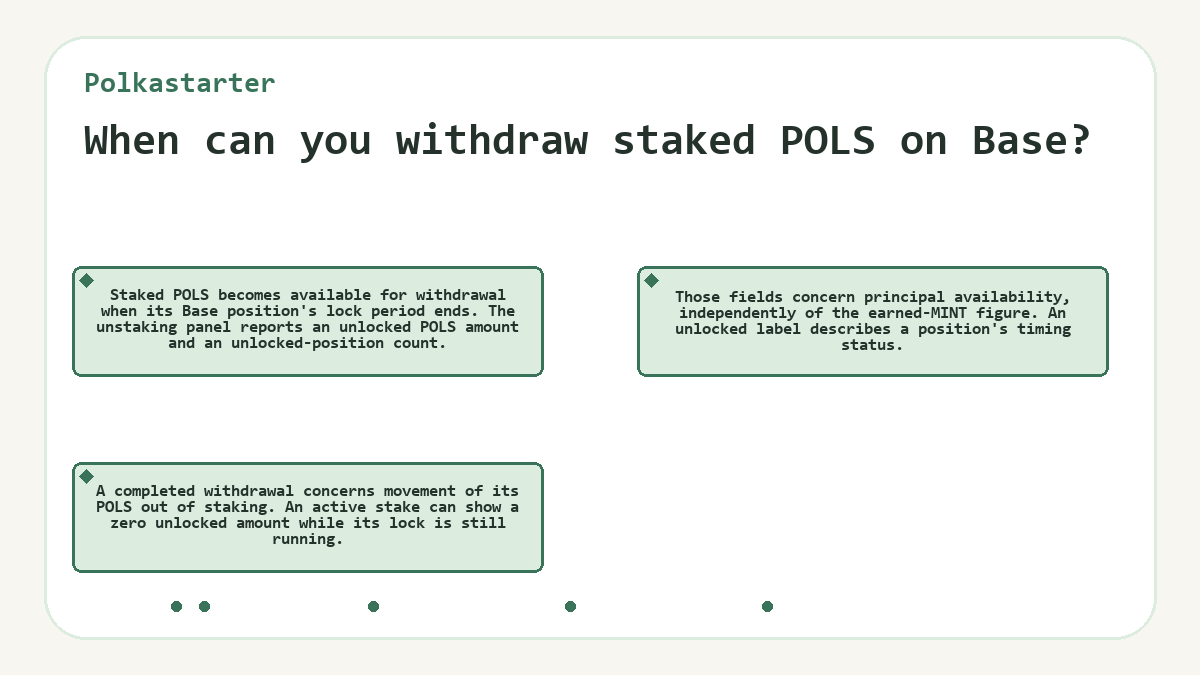
An unlocked label describes a position's timing status. A completed withdrawal concerns movement of its POLS out of staking. An active stake can show a zero unlocked amount while its lock is still running.
BSC snapshot allocations and automatic staking
The announced migration from BNB Chain (BSC) provided another entry path into Base staking. Eligible snapshot balances would receive POLS automatically, with allocations entering staking under the distribution conditions.
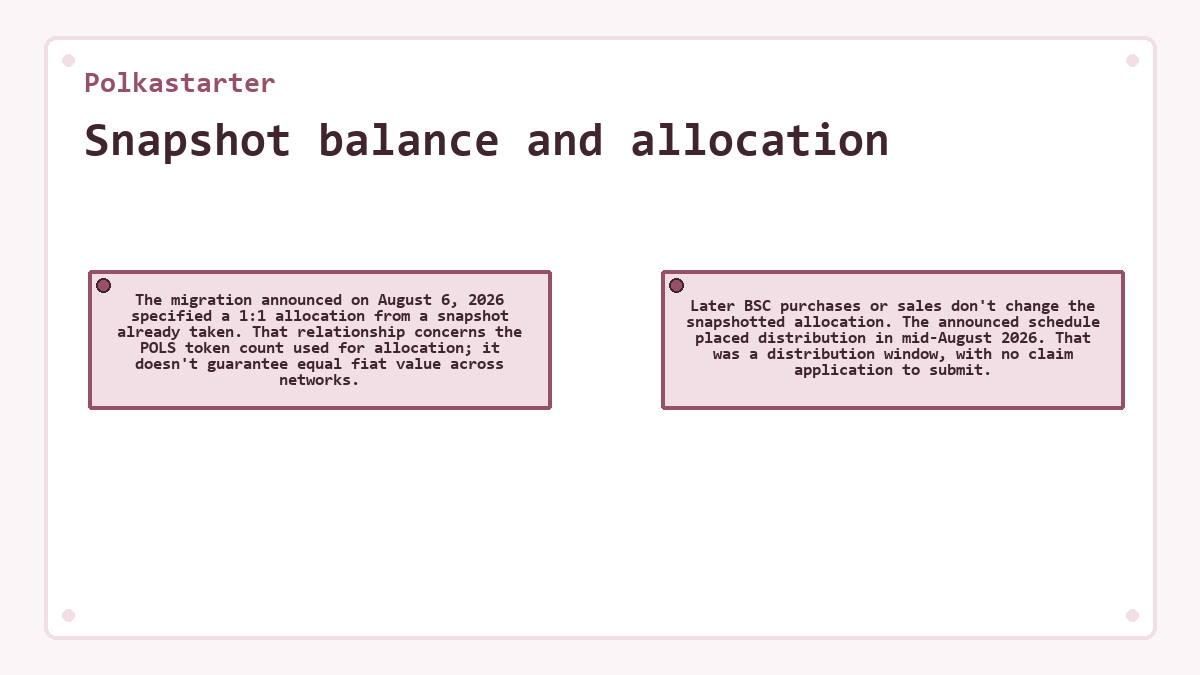
Snapshot balance and allocation
The migration announced on August 6, 2026 specified a 1:1 allocation from a snapshot already taken. That relationship concerns the POLS token count used for allocation; it doesn't guarantee equal fiat value across networks. Later BSC purchases or sales don't change the snapshotted allocation. The announced schedule placed distribution in mid-August 2026. That was a distribution window, with no claim application to submit.
Migration lock and reward bonus
The plan placed allocations into staking and tied full unlocking to completion of the distribution. It also specified a 1.5x staking-reward multiplier for BSC stakers. That factor concerns rewards on the qualifying migrated position; it doesn't enlarge the 1:1 principal allocation or establish an APR. The announcement described planned delivery; it didn't confirm receipt or unlocking for every individual wallet.
This migration required no claim transaction, signature, or claim fee. A request to authorize an airdrop claim conflicts with its automatic-delivery design.
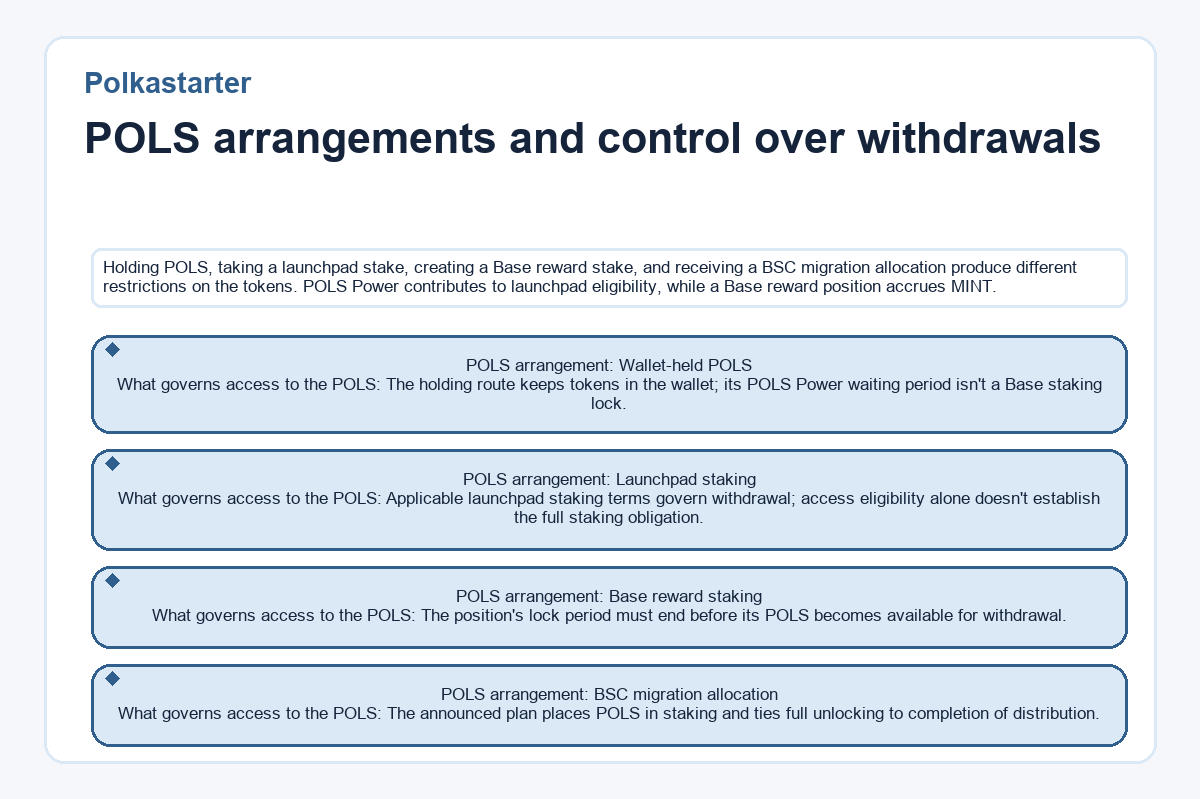
POLS arrangements and control over withdrawals
Holding POLS, taking a launchpad stake, creating a Base reward stake, and receiving a BSC migration allocation produce different restrictions on the tokens. POLS Power contributes to launchpad eligibility, while a Base reward position accrues MINT.
| POLS arrangement | What governs access to the POLS |
|---|---|
| Wallet-held POLS | The holding route keeps tokens in the wallet; its POLS Power waiting period isn't a Base staking lock. |
| Launchpad staking | Applicable launchpad staking terms govern withdrawal; access eligibility alone doesn't establish the full staking obligation. |
| Base reward staking | The position's lock period must end before its POLS becomes available for withdrawal. |
| BSC migration allocation | The announced plan places POLS in staking and ties full unlocking to completion of distribution. |
Does the launchpad's seven-day rule apply to Base staking?
Seven-day launchpad rules don't establish a universal Base staking term. POLS Power documentation describes a seven-day holding period and a seven-day staking lock on Ethereum or BNB Chain. Launchpad terms dated December 28, 2024 separately state a 90-day staking obligation, with possible loss of vested tokens for early unstaking. A Base position's displayed unlock date describes contract timing, separate from any applicable launchpad participation obligation. Keeping POLS in a wallet, by comparison, doesn't create a Base reward position.
Quick answers about Polkastarter
What can an empty Base staking dashboard show before a wallet is linked?
An unlinked dashboard can show zero active stake, zero unlocked POLS, and no positions while also stating that no wallet is linked. Those values don't establish the holdings of a particular address. The screen can also leave contract durations or token details unresolved in that state, so an empty view alone doesn't prove a deposit disappeared.
Can POLS held on Ethereum reach the Base staking ecosystem?
POLS held on Ethereum has a bridging route to Base. Ethereum holders use a bridge, while qualifying BSC snapshot allocations follow automatic delivery and staking. The Base staking record identifies POLS committed to a reward position; an Ethereum wallet balance alone doesn't establish such a position.
Where does the BSC migration bonus sit relative to longer staking locks?
The migration explanation updated September 9, 2026 places the qualifying BSC staker bonus at 1.5x and the longest-lock reward maximum at 2.5x. These figures multiply rewards, not the number of POLS deposited. A new Base stake follows the multiplier and duration offered for that position; the migration bonus doesn't establish its terms.
Are XP Points part of my staked POLS balance?
XP Points have a prize-related role separate from the POLS held in a staking position. The Base staking launch described XP alongside MINT rewards, with prizes such as physical cards, video games, and free packs. POLS principal, MINT rewards, and XP Points therefore use different units and shouldn't be combined into one token balance.
Does a Base MINT-reward position guarantee an IDO allocation?
An IDO allocation requires selection under that offering's access rules. The POLS Power documentation describes an allowlisting lottery, so meeting eligibility conditions doesn't assure selection. A Base reward position alone doesn't establish an allowlist result or override an offering's verification and access requirements.