 Polkastarter
 tokenomics - POLS supply and utility
Polkastarter tokenomics combines an original supply of 100 million POLS with launchpad access and separate MINT staking rewards. POLS Power measures eligibility for initial decentralized offerings, or IDOs. Marketplace Credits fund eligible collectible purchases and don't share the POLS supply model or token-sale privileges.
Last updatedIn short: A Base staking reward balance is denominated in MINT, so it doesn't measure growth in the deposited POLS principal.
Launchpad access, Base rewards, and purchase credits
The intended use determines which balance matters: qualifying staked POLS contributes to launchpad access, while Base staking accrues MINT rewards. Collectible purchases use Marketplace Credits under their own terms, without a requirement to own POLS. Buying credits therefore doesn't establish a POLS position.
A launchpad stake supports eligibility for project token sales. A Base position commits POLS for a lock period and earns a different asset. Credits provide purchasing capacity within the marketplace. Their common branding doesn't combine their balances, withdrawal conditions, or participation rights. POLS Power also remains an eligibility measure, rather than another supply of transferable POLS.
POLS supply and the launch distribution
The original POLS token model specified a total supply of 100 million tokens. Its September 29, 2020 launch figures included 17.875 million POLS in initial circulation. The launch distribution recorded 42.5 million POLS sold, representing 42.5% of the original total.
Total supply measures token quantity; initial circulation describes the portion circulating at launch.
Sold allocations and circulating tokens aren't interchangeable. An allocation can belong to a buyer while its release schedule restricts availability.
A historical launch balance doesn't establish today's tradable float. Later releases and transfers change availability, while staking introduces another restriction on specific holdings. An original allocation chart also doesn't identify the present holder of every token.
Release schedules and the available float
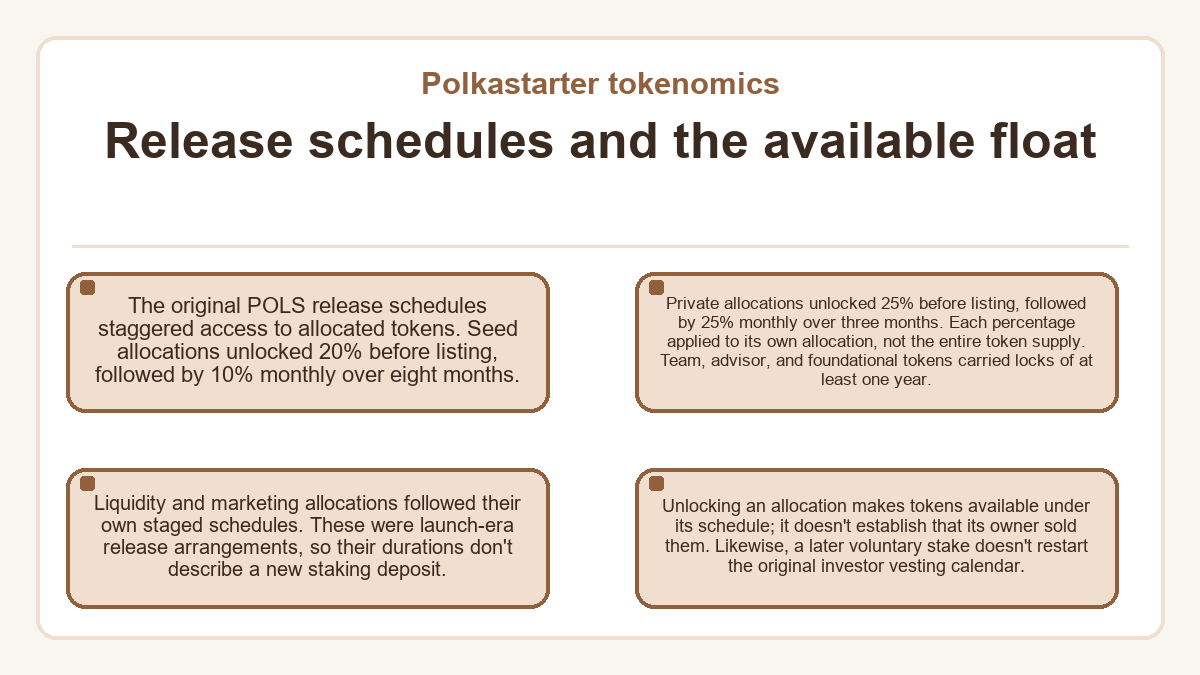
The original POLS release schedules staggered access to allocated tokens. Seed allocations unlocked 20% before listing, followed by 10% monthly over eight months. Private allocations unlocked 25% before listing, followed by 25% monthly over three months. Each percentage applied to its own allocation, not the entire token supply.
Team, advisor, and foundational tokens carried locks of at least one year. Liquidity and marketing allocations followed their own staged schedules. These were launch-era release arrangements, so their durations don't describe a new staking deposit. Unlocking an allocation makes tokens available under its schedule; it doesn't establish that its owner sold them. Likewise, a later voluntary stake doesn't restart the original investor vesting calendar.
What does staking change about POLS supply?
Staking restricts access to deposited POLS for the position's lock period while preserving a POLS-denominated principal. A lock and a token burn have different consequences: the staking interface provides for withdrawal once the position unlocks. A lower spendable wallet balance alone doesn't establish a reduction in total token supply.
In this hypothetical example, a linked Base wallet holds 1 246 POLS and has no staking positions. Its wallet balance appears alongside an empty stake summary. The expected staking balance is zero because the tokens remain in the wallet.
Keeping those tokens in the wallet leaves 1 246 POLS unstaked. Committing the full amount to a confirmed Base stake would create a position with 1 246 POLS principal. The comparison concerns the same token quantity; only its availability and participation in Base rewards change.
The all filter in the stake summary shows positions without changing the deposit. Checking it with the wallet used for the stake can reveal the matching 1 246-POLS entry. If the position is locked, its principal isn't yet available for withdrawal. If no matching entry appears, the displayed wallet holding alone doesn't establish a completed stake. A MINT reward total cannot substitute for the POLS position record.
A staking position's unlock date governs access to that deposit. It doesn't measure how much MINT the position has earned.
Access utility and the cost of committing POLS
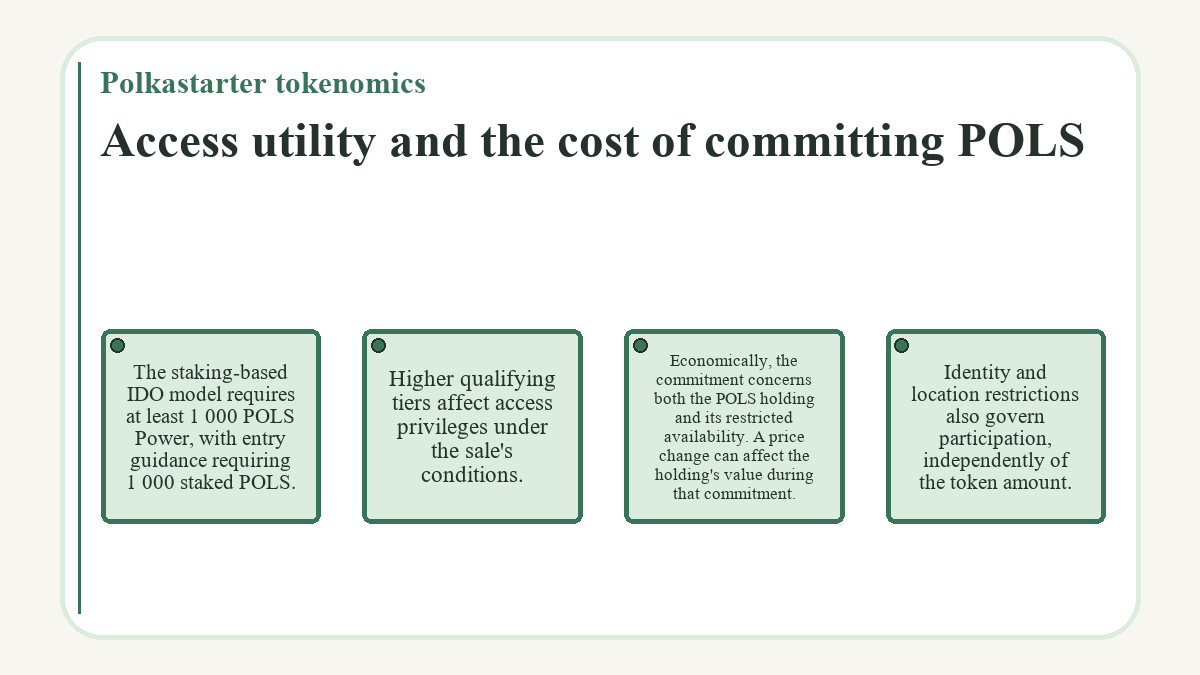
The staking-based IDO model requires at least 1 000 POLS Power, with entry guidance requiring 1 000 staked POLS. Higher qualifying tiers affect access privileges under the sale's conditions. Economically, the commitment concerns both the POLS holding and its restricted availability. A price change can affect the holding's value during that commitment. Identity and location restrictions also govern participation, independently of the token amount.
MINT rewards and POLS valuation
MINT rewards belong to a different token balance from deposited POLS. An estimated reward value therefore doesn't measure additional POLS principal. The Base interface identifies annual percentage rate, or APR, as an estimate that may vary. Polkastarter's token-distribution guide, updated September 9, 2026, describes MINT as not yet market-traded. The dashboard's monetary estimate doesn't establish a realizable sale value.
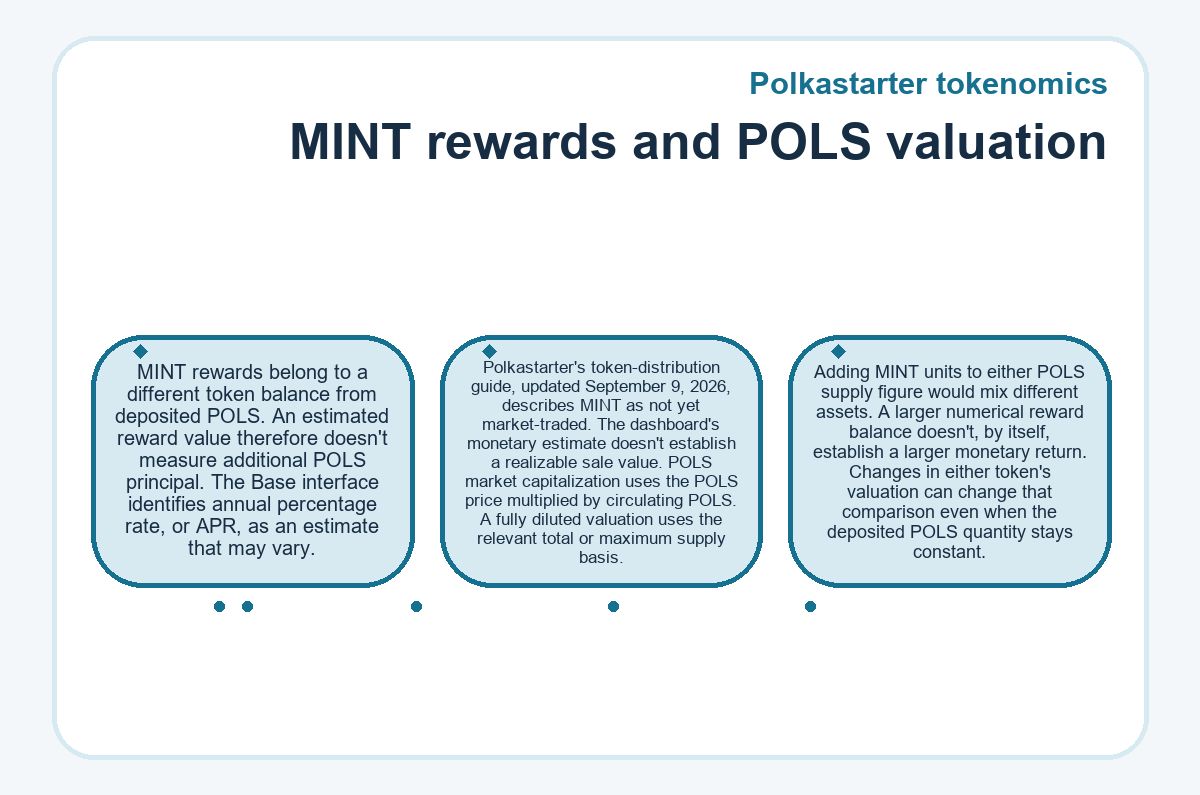
POLS market capitalization uses the POLS price multiplied by circulating POLS. A fully diluted valuation uses the relevant total or maximum supply basis. Adding MINT units to either POLS supply figure would mix different assets. A larger numerical reward balance doesn't, by itself, establish a larger monetary return. Changes in either token's valuation can change that comparison even when the deposited POLS quantity stays constant.
Base migration and cross-chain balance counting
The BSC-to-Base migration plan announced on August 6, 2026 specified a snapshot-based, 1:1 POLS allocation for automatic delivery into locked staking positions, with full unlocking once distribution is complete. Its allocation concerned POLS on Base, independently of MINT earnings. Ethereum holders have a separate Ethereum-to-Base bridge route. A shared destination doesn't make those entry arrangements interchangeable.
The announced BSC distribution required no claim transaction, signature, or payment. A request to sign or pay to claim that specific allocation contradicts its automatic delivery mechanism. The announcement described an entitlement and delivery plan; a matching migration position on Base records receipt of that allocation for the snapshot wallet. Neither the announcement nor another holder's receipt establishes delivery to every eligible address.
A 1:1 allocation rate also doesn't resolve global supply accounting across chains. Raw contract totals require reconciliation with the bridge's accounting and the migration's treatment of existing balances before they represent an aggregate supply. The original POLS launch total and the balances reported by different networks describe different accounting contexts.
Marketplace spending without POLS exposure
Marketplace Credits provide purchasing capacity for eligible collectibles without requiring users to purchase, hold, trade, or stake POLS. Their terms limit spending to the marketplace and exclude token launches, POLS staking, and fundraising. Fiat funding through supported payment providers therefore purchases marketplace capacity, not launchpad eligibility.
Credits don't earn interest or confer investment rights in the broader ecosystem. Promotional credits may also carry different conditions from purchased credits. This distinction limits what marketplace activity establishes about POLS demand: a collectible purchase alone doesn't demonstrate a POLS purchase or stake. Access to a particular funding method depends on jurisdiction, identity verification, and the payment provider's requirements.
Polkastarter tokenomics: common questions
-
What were the original POLS seed and private sale prices?
- The original seed sale price was US$0.0125 per POLS, and the private sale price was US$0.025 per POLS. These were historical fundraising prices. They don't describe a current market quote, the cost of a Base staking position, or the purchase price of another project's IDO token.
-
Can buying BSC POLS after the migration snapshot increase the airdrop?
- Purchases after the recorded snapshot don't increase the snapshot-based Base allocation. The announced migration used holdings captured before the stated divergence between chain prices.
-
Does the BSC migration's 1.5x bonus enlarge the POLS principal?
- The announced 1.5x bonus for BSC stakers applies to staking rewards, not the migrated POLS principal. The separate 1:1 term describes the POLS allocation. Neither figure fixes the monetary value of the resulting position.
-
Will an Ethereum-to-Base POLS transfer settle within a fixed time?
- The bridge displays an estimated transfer time, which doesn't establish a fixed settlement deadline. Its quoted network fee and expected received amount also belong to the selected transfer. A bridge estimate shouldn't be applied to the automatic BSC snapshot distribution, which uses a different delivery mechanism and eligibility basis.
-
Where does the 90-day POLS staking obligation apply?
- The launchpad's Terms & Conditions, last updated December 28, 2024, describe a 90-day obligation for staking to participate. They associate early unstaking with penalties, including possible loss of vested tokens. That participation obligation doesn't supply the unlock date for a Base reward position; the position's own lock and applicable product terms govern that deposit.
-
Does staking POLS automatically pay for an IDO token purchase?
- Staking POLS establishes a qualifying commitment under the applicable access rules; it doesn't itself pay for a project's sale tokens. A fixed-swap pool prices the project's tokens, and participation requires funding the purchase under that offering's conditions. The POLS stake, permitted purchase allocation, and acquired project tokens represent different amounts and assets.