 Polkastarter
 POLS Power Requirements for IDO Access
Polkastarter POLS Power measures eligibility for an initial decentralized offering, or IDO, using qualifying staked POLS and staking duration. The staking-based rules require at least 1 000 POLS Power, and unstaked wallet holdings don't count. A six-hour snapshot cycle can delay the displayed update after staking. Older material describes a 250-POLS ticket model with wallet-holding eligibility. Those rules belong to a different model and shouldn't be carried into the staking-based calculation. Higher tiers affect allocation priority and cooldown exemptions.
Last updatedStaked POLS and launchpad tier thresholds
The launchpad's minimum is 1 000 POLS Power, with published entry guidance requiring 1 000 staked POLS. Its tier display runs from Bronze through Diamond. Each threshold sets access benefits, independently of the sale tokens a participant actually purchases.
| POLS Power parameter | Published value | Launchpad effect |
|---|---|---|
| Bronze threshold | 1 000 POLS Power | Entry eligibility with a qualifying stake |
| Silver threshold | 3 000 POLS Power | Higher lottery tier |
| Gold threshold | 10 000 POLS Power | Higher lottery tier |
| Platinum threshold | 30 000 POLS Power | Cooldown exemption; other participation conditions remain |
| Diamond threshold | 50 000 POLS Power | Guaranteed allocation benefit under the sale's access rules |
| Score snapshots | Every six hours | Updates to staking-based POLS Power |
A Power threshold describes access status. The staked POLS balance describes tokens committed to staking, while a sale allocation describes a purchase allowance.
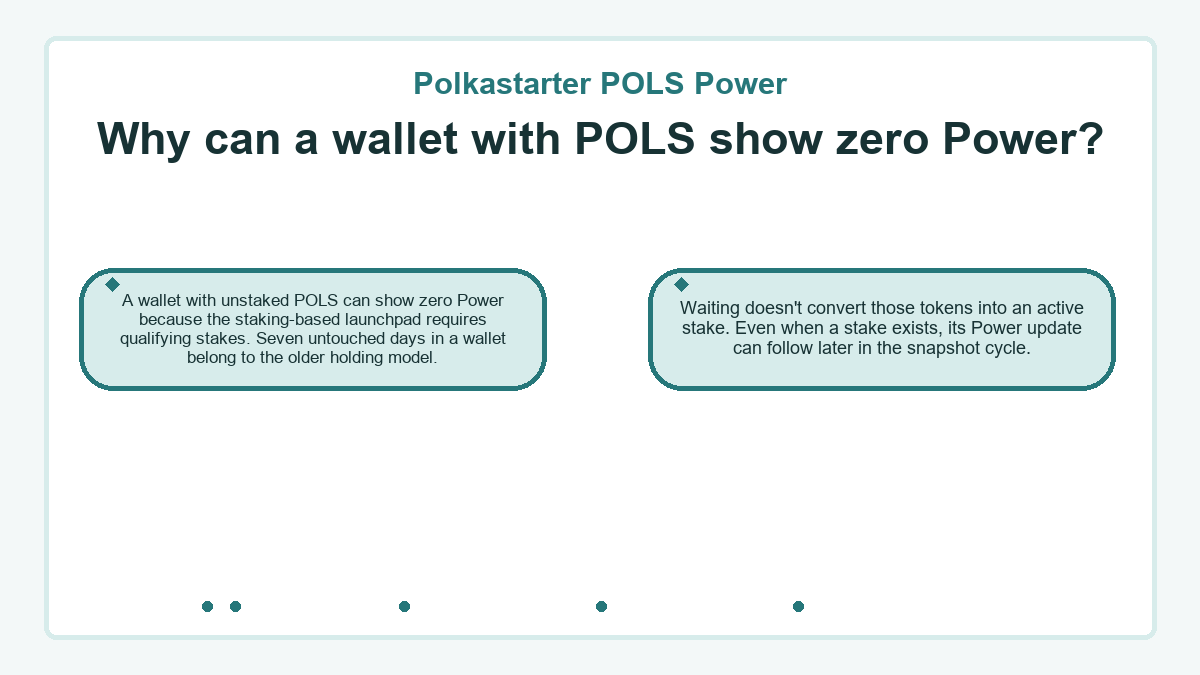
Why can a wallet with POLS show zero Power?
A wallet with unstaked POLS can show zero Power because the staking-based launchpad requires qualifying stakes. Seven untouched days in a wallet belong to the older holding model. Waiting doesn't convert those tokens into an active stake. Even when a stake exists, its Power update can follow later in the snapshot cycle.
Snapshot timing and project applications
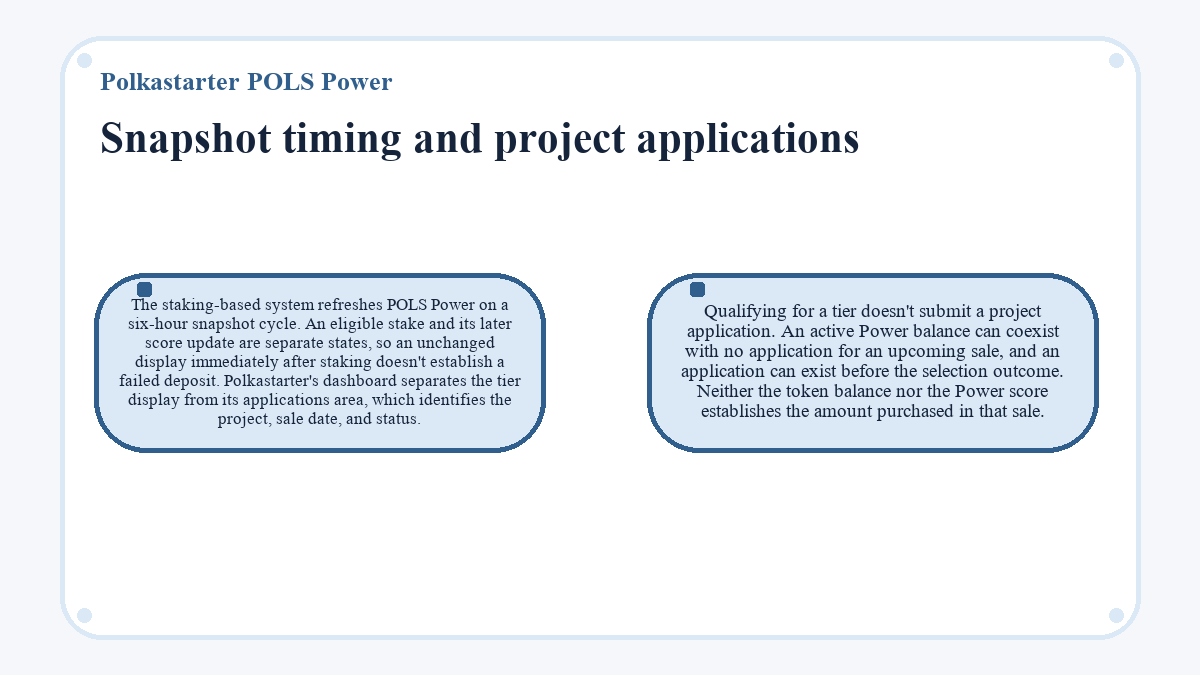
The staking-based system refreshes POLS Power on a six-hour snapshot cycle. An eligible stake and its later score update are separate states, so an unchanged display immediately after staking doesn't establish a failed deposit.
Polkastarter's dashboard separates the tier display from its applications area, which identifies the project, sale date, and status. Qualifying for a tier doesn't submit a project application. An active Power balance can coexist with no application for an upcoming sale, and an application can exist before the selection outcome. Neither the token balance nor the Power score establishes the amount purchased in that sale.
Does a higher tier guarantee an IDO allocation?
Diamond provides a guaranteed allocation at 50 000 POLS Power, subject to the sale's application and eligibility requirements; the lower displayed tiers use lottery-based access.
Lottery probabilities below Diamond
The probability display uses averages from recent IDOs, so its percentages aren't fixed odds for the next sale. A higher tier offers better priority and larger allocations, while a recent average describes earlier outcomes. It doesn't establish a particular application's selection result.
Pool creators can set different purchase allowances for eligible participants. A larger allocation concerns how much a wallet may buy, separately from its probability of selection.
Diamond access and the first allocation window
The staking-based Community FAQ describes Diamond access for private and public rounds, with a four-hour allocation window in the first IDO phase. That window provides an opportunity to fund an allocation. It doesn't complete the purchase or remove the sale's identity and location conditions.
Cooldowns after funding and other access restrictions
The allocation that starts the wait
The seven-day IDO cooldown begins when a participant allocates funds to a sale. Merely getting onto the allowlist doesn't start it. This distinction also applies to the first-come, first-served round, commonly shortened to FCFS.
Qualifying staking of at least 30 000 POLS removes the cooldown. Other participation conditions remain, including applicable identity checks. Cooldown exemption and Diamond's guaranteed allocation describe different privileges; the former begins at Platinum.
Identity, location, and account rules
Fundraising entities choose whether to use Know Your Customer, or KYC, tools. At a fundraiser's or competent regulator's request, Polkastarter can seek identity documents and restrict service until it establishes identity. Participants must also meet both the minimum age of 18 and their jurisdiction's age of majority.
The December 28, 2024 launchpad terms exclude people located in or resident in the United States, North Korea, Iran, Venezuela, and other prohibited jurisdictions. They also exclude politically exposed persons and people on applicable sanctions or watch lists. Creating multiple accounts to improve allocation chances breaches the participation rules. The terms provide for linked account closures and freezing associated tokens.
Legacy tickets and separate staking commitments
The older token-utility model awarded one ticket per 250 POLS and counted wallet holdings after seven untouched days. Its five tiers increased ticket weight by up to 25%. It also described Ethereum and BNB Chain staking as providing immediate application eligibility, with a seven-day withdrawal lock. These parameters describe that model, rather than a universal formula for every subsequent sale.
Polkastarter's March 19, 2025 Community FAQ, updated September 9, 2026, requires 1 000 staked POLS for sale participation. Broader Power descriptions also name ETH/POLS liquidity on Uniswap and BNB/POLS liquidity on PancakeSwap. Those liquidity routes don't replace an explicit staking requirement for the applicable offering.
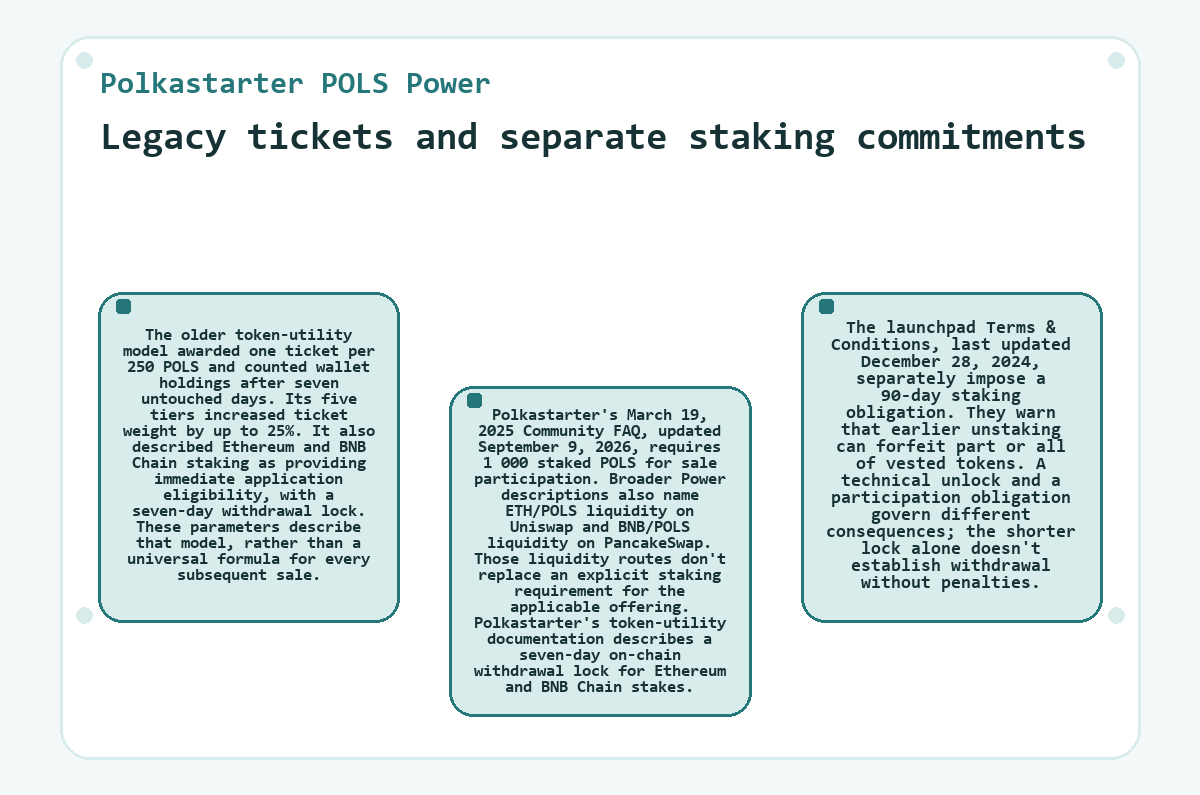
Polkastarter's token-utility documentation describes a seven-day on-chain withdrawal lock for Ethereum and BNB Chain stakes. The launchpad Terms & Conditions, last updated December 28, 2024, separately impose a 90-day staking obligation. They warn that earlier unstaking can forfeit part or all of vested tokens. A technical unlock and a participation obligation govern different consequences; the shorter lock alone doesn't establish withdrawal without penalties.
Base rewards and the launchpad score
Base staking reports locked POLS positions and MINT rewards, which don't establish an IDO allocation. The BNB Chain migration announcement concerns automatic Base staking, without confirming any particular token-sale application. Marketplace Credits belong to collectible purchases and can't fund POLS staking. For sale participation, the applying wallet's qualifying launchpad Power and application status must satisfy that offering's access conditions.
Good to know
Does applying to an allowlist spend my POLS?
An allowlist application doesn't spend your POLS. Your qualifying balance supplies the basis for launchpad access, while funding a sale allocation is a separate commitment. Applying doesn't release staked tokens or cancel their lock. The amount you may purchase comes from the offering's allocation rules, rather than a deduction from Power.
Can POLS Power from one wallet qualify another wallet?
POLS Power is calculated per wallet, so one address's qualifying stake doesn't automatically give another address the same score. The wallet associated with a project application needs its own recognized eligibility. Signing into an account doesn't establish that a different wallet's stake belongs to the applying address.
What happens to my POLS Power between IDOs?
Your POLS Power stays active between IDOs while the qualifying tokens remain staked. You don't have to withdraw and restake after each sale. A participation cooldown can still apply separately, so an active score doesn't always mean the wallet can fund another allocation immediately.
Can onboarding missions replace the minimum POLS stake?
The published entry requirement remains 1 000 staked POLS. The POLS Power guidance also describes onboarding bonuses of up to 500 Power for new users, but those credits aren't deposited POLS. A bonus to the score doesn't establish that an unstaked wallet satisfies the sale's staking requirement.
Who can receive my identity documents during an IDO application?
Polkastarter's launchpad terms permit sharing submitted KYC information with third parties to verify its authenticity. This concerns identity and location checks associated with participation, independently of the wallet's Power. A qualifying tier doesn't remove an identity request, and a sale requiring verification can restrict access until the checks are satisfied.
Does a POLS Power tier determine a sale token's purchase price?
A pool's fixed sale price is independent of the wallet's POLS Power tier. The project sets that pool's sale price, while allocation rules determine how much an eligible wallet may purchase. Higher Power can change access priority or allocation benefits without establishing a discounted token price.