 Polkastarter
 supports fixed-price token sales and a separate collectibles marketplace
Polkastarter is a Web3 fundraising platform for fixed-price token sales, alongside a separate marketplace for trading cards and games. Its launchpad covers initial decentralized offerings, or IDOs, NFT sales, and gaming projects. Token-sale eligibility follows the offering's access conditions, independently of collectible purchase requirements.
Last updatedBottom line: A fixed sale price governs the token purchase, while each project's access conditions determine who can participate.
Token pools, POLS, and collectible purchases
Token pools provide the fundraising mechanism, POLS contributes to launchpad access, and Marketplace Credits pay for eligible collectibles.
Fundraising projects use pools to distribute tokens in exchange for funding and develop their communities. The multi-chain fundraising setup spans Ethereum, BNB Chain, Polygon, Celo, and Avalanche. Each offering has its own network context; this breadth doesn't make a balance usable across every chain.
POLS Power measures eligible POLS for sale access. The wallet-holding route requires tokens to remain unmoved for at least 7 days before they count. Qualifying launchpad staking provides immediate access to IDO applications; withdrawal remains subject to the stake's lock conditions. Supported liquidity positions include ETH/POLS on Uniswap and BNB/POLS on PancakeSwap.
Fixed sale prices and conditional allocations
A fixed-swap pool sets a project's token purchase price, while its access settings determine eligible wallet addresses. Pool creators can offer different allocation amounts, so a common sale price doesn't imply identical purchase allowances.
During a sale, a fixed-swap pool keeps its token purchase price unchanged until its initial supply runs out. This rule concerns purchases within the fundraising pool. It doesn't peg the token's later market price or promise liquidity after the sale.
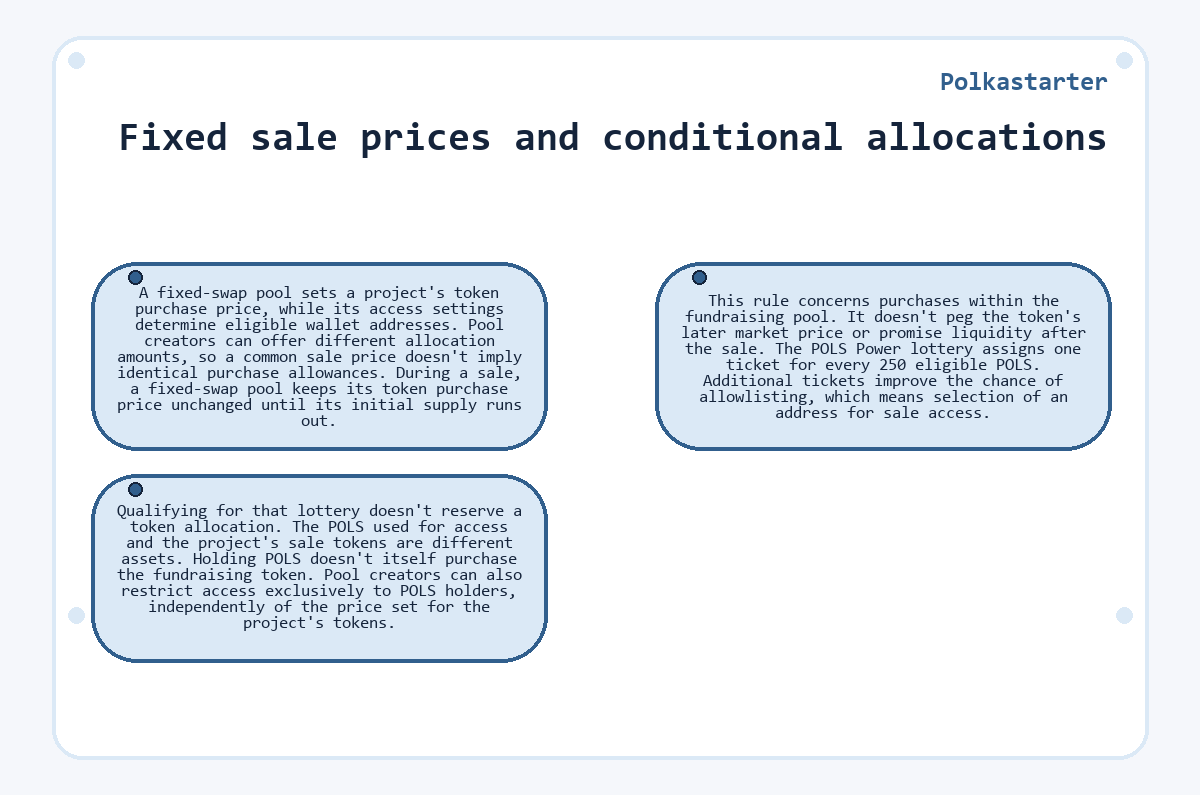
The POLS Power lottery assigns one ticket for every 250 eligible POLS. Additional tickets improve the chance of allowlisting, which means selection of an address for sale access. Qualifying for that lottery doesn't reserve a token allocation.
The POLS used for access and the project's sale tokens are different assets. Holding POLS doesn't itself purchase the fundraising token. Pool creators can also restrict access exclusively to POLS holders, independently of the price set for the project's tokens.
Which conditions determine IDO eligibility?
IDO eligibility combines the offering's access criteria with applicable location and identity restrictions. The launchpad's December 28, 2024 terms exclude people located in or resident in the United States, North Korea, Iran, or Venezuela. They also exclude politically exposed persons, people on applicable sanctions or watch lists, and anyone located in or resident in other prohibited jurisdictions. Being a citizen of another country doesn't override a restriction tied to someone's actual location.
Know Your Customer, or KYC, tools let fundraising entities require identity checks for their offerings. The general framework leaves their use to those entities. The service can also request identity or location documents at a fundraising entity's or regulator's request. Submitted information may go to third parties for verification. Sale selection doesn't override these checks, and marketplace verification doesn't establish eligibility for an IDO.
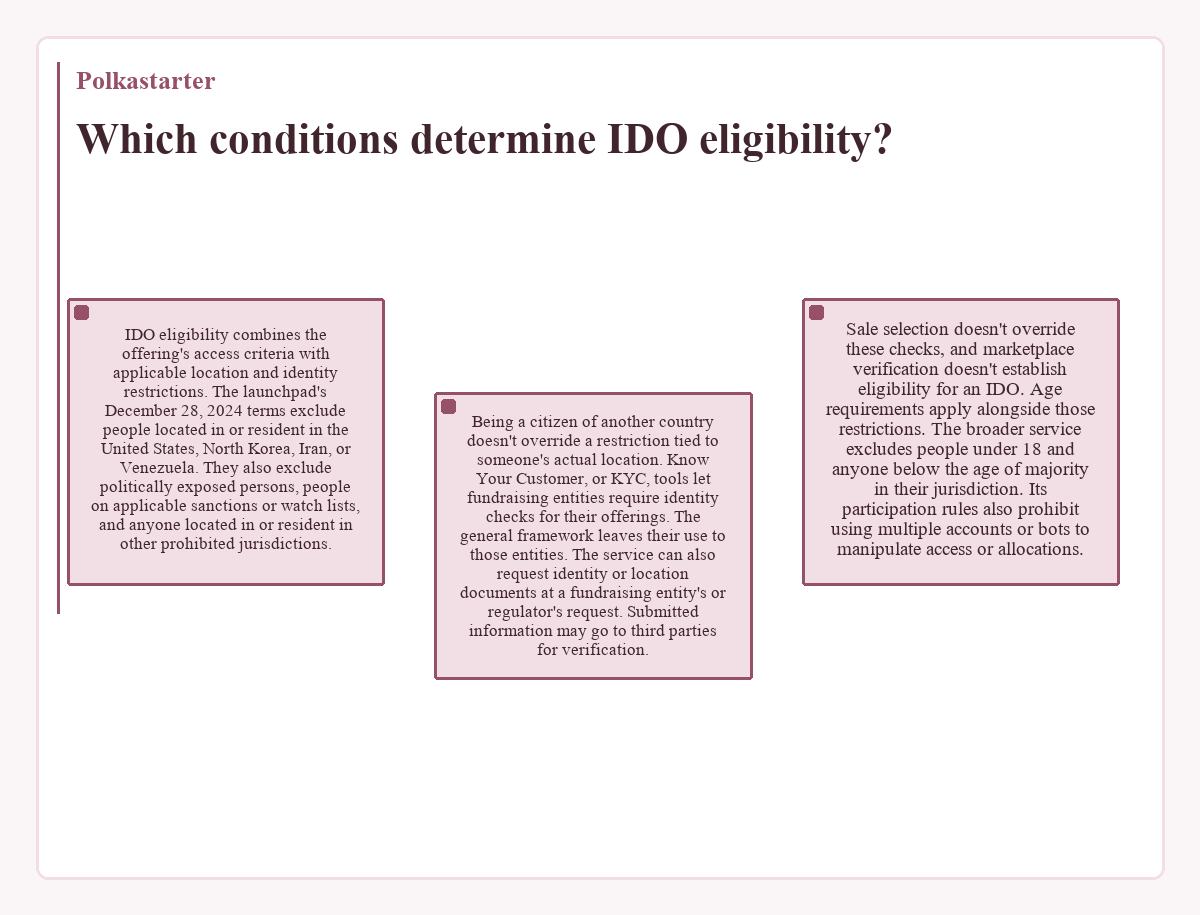
Age requirements apply alongside those restrictions. The broader service excludes people under 18 and anyone below the age of majority in their jurisdiction. Its participation rules also prohibit using multiple accounts or bots to manipulate access or allocations.
Marketplace Credits and collectible rights
Marketplace Credits fund eligible purchases within the collectibles marketplace without requiring POLS ownership. Users must meet the higher of 18 or their jurisdiction's applicable legal age. Certain features may require identity, email, or phone verification, and payment availability varies with country and provider requirements.
Supported third-party payment services can fund purchased credits, including Uphold where available. The funding process discloses the exchange rate, fees, and total payment amount. A provider may require additional identity checks or payment authorization. Those transactions fund marketplace purchases; they don't purchase POLS or establish a staking position.
Marketplace Credits cannot be used to participate in token fundraising. Credits also don't earn interest. Their permitted uses remain within the marketplace, and any expiration, withdrawal, or redemption conditions belong to the applicable credit terms. Promotional credits can carry different restrictions.
Collectible rights follow the individual product description and marketplace rules. A digital item may arrive in an account or associated inventory, while transfer, resale, and redemption rights depend on that item. Packs may contain randomized collectible rewards. A right to redeem a digital item for a physical collectible must form part of that product's stated terms.
Consider a hypothetical purchaser with an identity-verified marketplace account and purchased Marketplace Credits. They're asking whether that balance covers an eligible collectible pack and an IDO allocation.
The credits can fund the pack if its listing permits that use and the purchase meets its conditions. They contribute no POLS Power and can't finance the IDO. Any identity checks the fundraising project requires remain separate from the marketplace verification.
Polkastarter - Token Sales, Collectibles, and Eligibility
- Which conditions determine IDO eligibility?
- Marketplace Credits and collectible rights
- Separate terms for staking and sale-token delivery
- Base migration and network-specific positions
Separate terms for staking and sale-token delivery
Published launchpad lock rules differ: the token-utility page describes 7 days, while the December 28, 2024 terms impose a 90-day obligation and early-unstaking penalties, including possible loss of vested tokens. Base reward staking has separate lock terms. Where a token sale imposes vesting, its purchased tokens follow that separate schedule. A POLS stake's unlock date therefore doesn't establish when a project's sale tokens become deliverable or transferable.
Base migration and network-specific positions
The BNB Chain (BSC) migration announcement of August 6, 2026 specified an automatic 1:1 distribution of POLS on Base to snapshotted addresses. Eligibility belonged to the snapshot. Later purchases on BNB Chain didn't enlarge the announced allocation.
The announced tokens were to arrive already staked, with unlocking tied to completion of the distribution. That condition concerns automatically migrated positions. Voluntary stakes follow their own lock terms.
The automatic airdrop required no claim form, wallet signature, or fee. A message demanding a signature or payment to claim this distribution is phishing. Separate marketplace promotions can require account verification.
The Base reward program pairs MINT rewards with XP Points intended for prizes, including physical cards, video games, and free packs. These reward units serve a different purpose from the launchpad's POLS Power. For BSC stakers covered by the migration, the specified staking-reward multiplier was 1.5x.
Polkastarter: the short answers
Can teams use the fixed-swap infrastructure beyond public token launches?
The fixed-swap infrastructure can support password-protected over-the-counter deals, discounted sales for allowlisted addresses, investment syndicates, and crowdfunding. Each use applies the pool mechanism to a different fundraising or trading arrangement, with access conditions specific to that arrangement.
Are free mystery packs subject to eligibility checks?
Free collectible packs may require verification, qualifying account activity, or other promotional conditions. Promotional credits may also be restricted to specific products or activities. They aren't equivalent to purchased Marketplace Credits unless the promotion expressly says so, and duplicate accounts or automated activity cannot be used to abuse rewards.
What determines a refund for a marketplace purchase?
Refund eligibility depends on the product, its delivery status, the payment method, and applicable consumer protection law. Requests can go through the marketplace's designated support channels. A payment provider's refund procedures may also apply, and any statutory withdrawal right remains subject to legally valid exceptions.
Does listing a project mean Polkastarter guarantees its token?
Listing a project doesn't provide a warranty of its token's merit, legality, or financial character. KYC checks concern identity and compliance requirements; they don't establish a token's future value. A fixed sale price likewise concerns the fundraising transaction, independently of later trading prices or the project's progress.
Who operates the launchpad and collectibles marketplace?
Dotstart Technologies Ltd is the named operator of both the broader service and the standalone collectibles marketplace. The company is incorporated in the British Virgin Islands. Each service has its own terms, so shared operation doesn't make Marketplace Credits interchangeable with POLS or combine their access rules.